Category: Agentic and Autonomous Systems

This category is about Agentic and Autonomous Systems

  • Self-Adapting Language Models: Teaching AI to Learn and Improve Itself

    Self-Adapting Language Models
    Self-Adapting Language Models

    Large language models (LLMs) like GPT and others have transformed natural language processing with their impressive ability to understand and generate human-like text. However, these models are typically static once trained—they don’t adapt their internal knowledge or behavior dynamically when faced with new tasks or data. What if these powerful models could teach themselves to improve, much like humans do when they revise notes or study smarter?

    A recent breakthrough from researchers at MIT introduces Self-Adapting Language Models (SEAL), a novel framework that enables LLMs to self-adapt by generating their own fine-tuning data and update instructions. This blog post explores how SEAL works, why it’s a game-changer for AI, and what it means for the future of language models.

    The Problem: Static Models in a Changing World

    • LLMs are powerful but fixed: Once trained, their weights remain static during deployment.
    • Adapting to new tasks or information requires external fine-tuning: This process depends on curated data and manual intervention.
    • Current adaptation methods treat training data “as-is”: Models consume new data directly, without transforming or restructuring it for better learning.
    • Humans learn differently: We often rewrite, summarize, or reorganize information to understand and remember it better.

    SEAL’s Vision: Models That Learn to Learn

    SEAL is inspired by how humans assimilate new knowledge. For example, a student preparing for an exam doesn’t just reread textbooks; they rewrite notes, create diagrams, or generate practice questions to deepen understanding. Similarly, SEAL enables language models to:

    • Generate their own training data (“self-edits”) tailored to the task.
    • Specify how to update their weights, including optimization parameters.
    • Use reinforcement learning (RL) to improve these self-edits based on downstream task performance.
    • Perform persistent weight updates, enabling lasting adaptation.

    How Does SEAL Work? A Two-Loop Learning Process

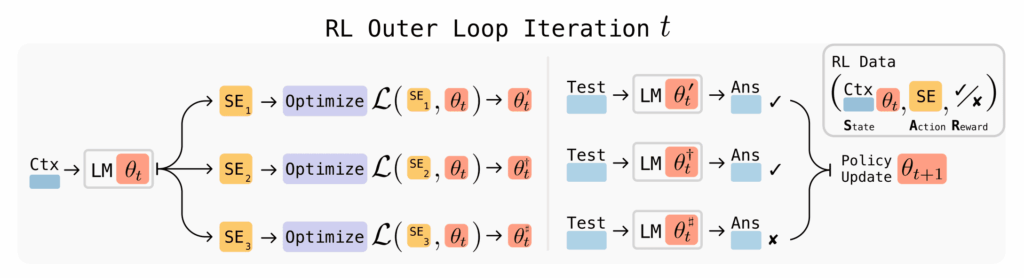
    SEAL’s training involves two nested loops:

    1. Outer Loop: Reinforcement Learning for Self-Edit Generation

    • The model receives a task context (e.g., a passage of text or few-shot examples).
    • It generates self-edits—natural language instructions that define synthetic training data and update strategies.
    • These self-edits act as actions in an RL framework.
    • The model’s updated performance on the task (after applying the self-edits) serves as a reward signal.
    • The model’s policy for generating self-edits is updated to maximize expected rewards.

    2. Inner Loop: Applying Self-Edits to Update Weights

    • The generated self-edits are used to fine-tune the model via supervised learning.
    • This results in new model parameters that hopefully perform better on the target task.
    • The updated model is then evaluated to provide feedback for the outer loop.

    Why Is SEAL Different and Important?

    • Self-Directed Adaptation: Unlike prior approaches that rely on separate modules or external data, SEAL uses the model’s own generations to drive adaptation.
    • Flexible and General: Self-edits can take many forms—rewriting passages, generating question-answer pairs, or specifying optimization settings.
    • Reinforcement Learning Optimizes Utility: The model learns to produce self-edits that actually improve downstream performance, not just plausible text.
    • Persistent Updates: Adaptation is not temporary; the model’s weights are updated, enabling lasting improvements.

    Real-World Applications and Results

    SEAL was tested on two key tasks:

    1. Knowledge Incorporation

    • Instead of fine-tuning directly on raw passages, SEAL generates synthetic data (self-edits) to train on.
    • This approach improved question-answering accuracy on a no-passage-in-context variant of the SQuAD dataset from 33.5% to 47.0%.
    • Notably, SEAL’s self-generated data outperformed synthetic data created by GPT-4, highlighting the advantage of task-specific, optimized self-edits.

    2. Few-Shot Learning

    • SEAL autonomously selects synthetic data augmentations and optimization hyperparameters (like learning rate and training epochs).
    • This automatic configuration outperformed standard in-context learning and naive self-editing without reinforcement learning.
    • The model effectively learned how to learn from few examples, improving generalization.

    How Does SEAL Fit Into the Bigger AI Landscape?

    • Synthetic Data Generation: SEAL builds on methods that create artificial training data but uniquely optimizes this data generation for maximal learning benefit.
    • Knowledge Updating: SEAL advances techniques that inject factual knowledge into LLMs through weight updates, but with a learned, adaptive strategy.
    • Test-Time Training: SEAL incorporates ideas from test-time training, adapting weights based on current inputs, but extends this with reinforcement learning.
    • Meta-Learning: SEAL embodies meta-learning by learning how to generate effective training data and updates, essentially learning to learn.
    • Self-Improvement: SEAL represents a scalable path for models to improve themselves using external data and internal feedback loops.

    Challenges and Future Directions

    • Training Stability: Reinforcement learning with model-generated data is complex and can be unstable; SEAL uses a method called ReSTEM (filtered behavior cloning) to stabilize training.
    • Generalization: While promising, further work is needed to apply SEAL to a broader range of tasks and larger models.
    • Cold-Start Learning: Future research may explore how models can discover optimal self-edit formats without initial prompt guidance.
    • Integration with Other Techniques: Combining SEAL with other adaptation and compression methods could yield even more efficient and powerful systems.

    Why You Should Care

    • SEAL pushes AI closer to human-like learning, where models don’t just passively consume data but actively restructure and optimize their learning process.
    • This could lead to language models that continuously improve themselves in deployment, adapting to new knowledge and tasks without costly retraining.
    • For developers and researchers, SEAL offers a new paradigm for building adaptable, efficient, and autonomous AI systems.

    Final Thoughts

    Self-Adapting Language Models (SEAL) open exciting possibilities for the future of AI. By teaching models to generate their own training data and fine-tuning instructions, SEAL enables them to self-improve in a principled, reinforcement learning-driven way. This innovation marks a significant step toward truly autonomous AI systems that learn how to learn, adapt, and evolve over time.

    For those interested in the cutting edge of machine learning, SEAL is a fascinating development worth following closely.

    Explore more about SEAL and see the code at the project website: https://jyopari.github.io/posts/seal

  • Enhancing Text-to-Image Diffusion Models with Efficient Token Pruning

    Enhancing Text-to-Image Diffusion Models with Efficient Token Pruning
    Enhancing Text-to-Image Diffusion Models with Efficient Token Pruning

    Text-to-image diffusion models have revolutionized the way AI generates images from textual descriptions, enabling stunning visual creativity. However, these models often come with hefty computational costs, limiting their efficiency and accessibility. A recent research paper introduces an innovative technique called Token Pruning that streamlines these models by intelligently reducing the number of tokens processed during image generation—without sacrificing quality. In this blog post, we’ll explore how token pruning works, why it matters, and what benefits it brings to the future of AI-powered image synthesis.

    The Challenge: Balancing Quality and Efficiency in Diffusion Models

    Diffusion models generate images by gradually transforming random noise into coherent visuals, guided by text prompts. The process involves complex neural networks that interpret the text and progressively refine the image. While powerful, these models face two main challenges:

    • High Computational Demand: Processing every token (word or subword) in a text prompt through multiple layers requires significant memory and compute resources.
    • Latency Issues: The extensive computation leads to slower image generation, which can hinder real-time applications or deployment on resource-constrained devices.

    Reducing the number of tokens processed could speed up inference, but naively dropping tokens risks losing important semantic information, degrading image quality.

    What Is Token Pruning?

    Token pruning is a technique that dynamically identifies and removes less important tokens during the forward pass of the diffusion model. Instead of treating all tokens equally, the model learns to focus on the most relevant parts of the text prompt at each stage of image generation.

    Key ideas behind token pruning include:

    • Dynamic Selection: Tokens are pruned based on their contribution to the current generation step, allowing the model to adaptively focus on critical information.
    • Layer-wise Pruning: Pruning decisions occur at multiple layers, progressively reducing token count as the model refines the image.
    • Preserving Semantics: The method ensures that essential semantic content is retained, maintaining image fidelity.

    How Does Token Pruning Work?

    The proposed approach integrates token pruning into the diffusion model’s architecture with the following components:

    • Importance Scoring: At each layer, tokens are assigned importance scores reflecting their relevance to the current generation task.
    • Pruning Mechanism: Tokens with low scores are pruned, reducing the computational load for subsequent layers.
    • Token Reweighting: Remaining tokens are reweighted to compensate for the pruned ones, preserving overall semantic balance.
    • End-to-End Training: The entire system is trained jointly, enabling the model to learn effective pruning strategies without manual intervention.

    Why Is This Breakthrough Important?

    Token pruning offers several compelling advantages for text-to-image diffusion models:

    • Reduced Computation: By processing fewer tokens, the model requires less memory and compute power.
    • Faster Inference: Pruning accelerates image generation, making diffusion models more practical for real-time or interactive applications.
    • Maintained Quality: Despite pruning, the approach preserves or even improves image quality by focusing on the most informative tokens.
    • Scalability: The method can be applied to various diffusion architectures and text encoders, enhancing flexibility.

    Real-World Benefits and Applications

    The efficiency gains from token pruning unlock new possibilities for AI-generated imagery:

    • Creative Tools: Artists and designers can enjoy faster iterations when generating visuals from text prompts.
    • Mobile and Edge Devices: Lightweight models enable deployment on smartphones and other devices with limited resources.
    • Interactive Experiences: Games, virtual reality, and augmented reality applications can integrate real-time text-to-image generation.
    • Cost Efficiency: Reduced computational demands lower cloud infrastructure costs for AI service providers.

    Summary of Key Contributions

    • Introduced a novel token pruning technique tailored for text-to-image diffusion models.
    • Developed a dynamic, layer-wise pruning strategy based on learned importance scores.
    • Demonstrated significant computational savings and faster inference without compromising image quality.
    • Validated the approach on standard benchmarks, showing competitive or superior performance.

    Looking Ahead: The Future of Efficient Image Generation

    Token pruning marks a significant step toward making powerful diffusion models more accessible and practical. As AI continues to evolve, combining such efficiency techniques with advances in model architecture and training will further democratize creative AI tools.

    Future research directions may include:

    • Extending pruning methods to other modalities like video or 3D generation.
    • Exploring adaptive pruning thresholds based on user preferences or hardware constraints.
    • Integrating token pruning with other compression and acceleration techniques.

    Final Thoughts

    The ability to generate high-quality images from text prompts is transforming creativity and communication. By intelligently pruning tokens, this new method makes diffusion models faster and more efficient—without sacrificing the rich detail and nuance that make AI-generated art so compelling.

    Whether you’re an AI researcher, developer, or enthusiast, token pruning offers exciting insights into how we can build smarter, leaner models that bring cutting-edge technology closer to everyday use.

    Stay tuned for more updates on innovations that push the boundaries of AI creativity and efficiency!

    Paper: https://arxiv.org/pdf/2506.10540

    If you enjoyed this deep dive into token pruning and diffusion models, follow our blog for more accessible explanations of the latest AI research breakthroughs.

  • Learning Conditional Class Dependencies: A Breakthrough in Few-Shot Classification

    A Call for Collaborative Intelligence: Why
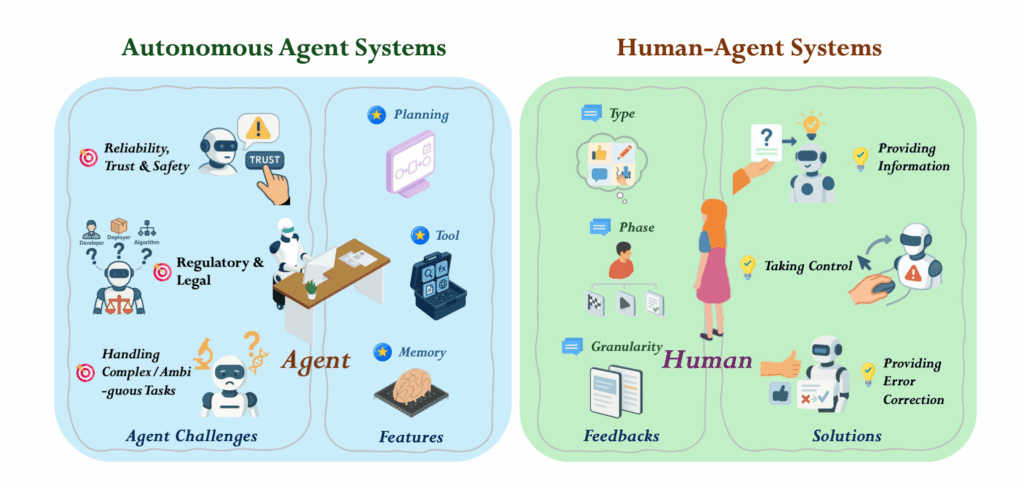
Human-Agent Systems Should Precede AI Autonomy
    A Call for Collaborative Intelligence: Why Human-Agent Systems Should Precede AI Autonomy

    Few-shot learning is one of the most exciting frontiers in artificial intelligence today. It aims to enable machines to recognize new classes or categories from just a handful of examples—much like humans do. However, teaching AI to learn effectively from such limited data remains a significant challenge. A recent research paper introduces a novel approach that leverages conditional class dependencies to dramatically improve few-shot classification. In this blog post, we’ll explore what this means, why it matters, and how it can transform AI’s ability to learn quickly and accurately.

    What Is Few-Shot Learning and Why Is It Hard?

    Traditional AI models rely heavily on large datasets to learn patterns and make predictions. For example, a model trained to recognize dog breeds might need thousands of labeled images for each breed. But in many real-world scenarios, collecting such extensive data is impractical or impossible.

    Few-shot learning addresses this by designing models that can generalize from just a few labeled examples per class. The goal is to mimic human learning efficiency, where a person can recognize a new object after seeing it only once or twice.

    Despite its promise, few-shot learning faces key challenges:

    • Data Scarcity: Few examples limit the model’s ability to capture the full range of variability within a class.
    • Class Similarity: Some categories are visually or semantically close, making it difficult to differentiate them with limited data.
    • Ignoring Class Relationships: Many existing methods treat each class independently, missing out on valuable contextual information.

    The Power of Conditional Class Dependencies

    Humans rarely consider categories in isolation. When identifying an object, we naturally use context and relationships between categories to guide our decision. For example, if you know an animal is a bird, it’s less likely to be a mammal.

    Conditional class dependencies refer to the relationships among classes that influence classification outcomes. In AI terms, this means the probability that a sample belongs to one class depends on the presence or absence of others.

    By explicitly modeling these dependencies, AI systems can make more informed predictions, especially when data is limited.

    Introducing a Novel Framework: Learning with Conditional Class Dependencies

    The recent research proposes a new framework that integrates conditional class dependencies into few-shot classification. Here’s how it works:

    Building a Class Dependency Graph

    Instead of treating classes as independent labels, the model constructs a graph where each node represents a class, and edges encode the dependencies or relationships between classes. This graph is learned dynamically during training, allowing the model to capture complex interactions among classes.

    Using Graph Neural Networks (GNNs) for Information Propagation

    Graph Neural Networks are powerful tools for learning on graph-structured data. In this framework, GNNs propagate information along the edges of the class dependency graph, enabling the model to refine its understanding of each class by considering related classes.

    Integrating with Few-Shot Learning

    When the model encounters new classes with only a few examples, it leverages the learned class dependency graph to make better predictions. By understanding how classes relate, the model can disambiguate confusing cases and improve accuracy.

    Why Does This Approach Matter?

    Incorporating conditional class dependencies brings several benefits:

    • Enhanced Accuracy: By considering class relationships, the model better distinguishes between similar classes.
    • Improved Generalization: The learned dependencies help the model adapt to new, unseen classes more effectively.
    • Human-Like Reasoning: Mimics the way humans use context and relationships to classify objects, especially when information is scarce.

    Real-World Applications

    This approach has broad implications across various domains:

    • Healthcare: Diagnosing diseases with overlapping symptoms can benefit from understanding dependencies between conditions.
    • Wildlife Conservation: Identifying rare species from limited sightings becomes more accurate by modeling species relationships.
    • Security: Rapidly recognizing new threats or objects with few examples is critical in surveillance.
    • Personalization: Enhancing recommendations by understanding how user preferences relate across categories.

    Experimental Evidence: Putting Theory into Practice

    The researchers evaluated their method on popular few-shot classification benchmarks and observed:

    • Consistent improvements over existing state-of-the-art models.
    • Better performance in scenarios involving visually or semantically similar classes.
    • Robustness to noisy or limited data samples.

    These results highlight the practical value of modeling conditional class dependencies in few-shot learning.

    The Bigger Picture: Towards Smarter, More Efficient AI

    This research aligns with a broader trend in AI towards models that learn more efficiently and reason more like humans. Key themes include:

    • Self-Supervised Learning: Leveraging unlabeled data and structural information.
    • Graph-Based Learning: Exploiting relationships and dependencies in data.
    • Explainability: Models that reason about class relationships offer better interpretability.

    Conclusion: A Step Forward in Few-Shot Learning

    Learning with conditional class dependencies marks a significant advance in few-shot classification. By explicitly modeling how classes relate, AI systems become better at making accurate predictions from limited data, generalizing to new classes, and mimicking human reasoning.

    As AI research continues to push boundaries, approaches like this will be crucial for building intelligent systems that learn quickly, adapt easily, and perform reliably in the real world.

    Paper: https://arxiv.org/pdf/2506.09420

    Stay tuned for more insights into cutting-edge AI research and how it shapes the future of technology.

  • The Illusion of Thinking: Understanding the Strengths and Limitations of Large Reasoning Models

    The Illusion of Thinking: Understanding the Strengths and Limitations of Large Reasoning Models
    The Illusion of Thinking: Understanding the Strengths and Limitations of Large Reasoning Models

    Recent advances in large language models (LLMs) have introduced a new class called Large Reasoning Models (LRMs), which generate detailed thought processes before producing answers. These models, such as OpenAI’s o1/o3, Claude 3.7 Sonnet Thinking, and Gemini Thinking, have shown promising results on reasoning benchmarks. However, their true reasoning capabilities, scaling behavior, and limitations remain unclear. This article summarizes key insights from the paper “The Illusion of Thinking: Understanding the Strengths and Limitations of Reasoning Models via the Lens of Problem Complexity” by Shojaee et al. (Apple), which investigates LRMs using controlled puzzle environments to analyze their reasoning beyond final answer accuracy.

    1. Motivation and Background

    • Emergence of LRMs: Recent LLMs incorporate “thinking” mechanisms such as long chain-of-thought (CoT) and self-reflection to improve reasoning.
    • Evaluation gaps: Existing benchmarks focus on final answer correctness, often suffer from data contamination, and lack insight into internal reasoning quality.
    • Key questions: Are LRMs truly reasoning or just pattern matching? How do they scale with problem complexity? How do they compare to standard LLMs with equal compute? What are their fundamental limitations?

    The authors argue that controlled environments with manipulable complexity and consistent logical structures are needed to rigorously evaluate LRMs’ reasoning.

    2. Experimental Setup: Controlled Puzzle Environments

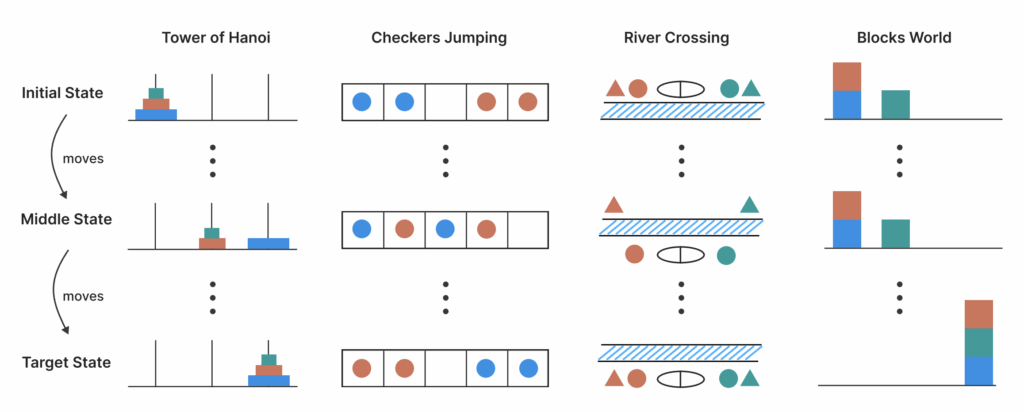
    To overcome limitations of standard benchmarks, the study uses algorithmic puzzle environments with these features:

    • Fine-grained complexity control: Puzzle complexity is systematically varied by changing puzzle elements while preserving logic.
    • No data contamination: Puzzles rely solely on explicit rules, avoiding memorization.
    • Algorithmic reasoning focus: Requires models to apply explicit algorithms.
    • Simulator-based evaluation: Enables precise verification of both final answers and intermediate reasoning steps.

    An example puzzle is the Tower of Hanoi, where the number of disks controls complexity.

    3. Key Findings

    3.1 Three Performance Regimes

    By comparing LRMs with standard LLMs under equal inference compute, three regimes emerge:

    • Low complexity: Standard LLMs outperform LRMs in accuracy and token efficiency.
    • Medium complexity: LRMs’ additional “thinking” leads to better accuracy but requires more tokens.
    • High complexity: Both LRMs and standard LLMs experience complete accuracy collapse.

    3.2 Counterintuitive Reasoning Effort Scaling

    • LRMs increase reasoning effort (measured by tokens generated during “thinking”) as complexity rises, but only up to a point.
    • Beyond a critical complexity threshold, reasoning effort declines sharply despite having sufficient token budget.
    • This suggests a fundamental limit in LRMs’ ability to scale reasoning with problem complexity.

    3.3 Limitations in Exact Computation and Algorithm Use

    • LRMs fail to consistently apply explicit algorithms across puzzles.
    • Reasoning is often inconsistent and error-prone, especially on complex tasks.
    • Models do not reliably use exact computation or systematic planning.

    3.4 Analysis of Reasoning Traces

    • Correct solutions tend to appear early in the reasoning trace for simple puzzles but later for moderate complexity.
    • LRMs often “overthink,” exploring many incorrect paths even after finding a correct one.
    • In high complexity cases, models frequently fixate on early wrong answers, wasting tokens without self-correction.
    • This reveals limited self-reflection and inefficient reasoning patterns.

    4. Implications for Reasoning Models

    • Questioning current evaluation: Sole reliance on final answer accuracy misses critical insights about reasoning quality.
    • Need for controlled testing: Puzzle environments provide a better framework to study reasoning mechanisms.
    • Scaling challenges: LRMs face inherent limits in scaling reasoning depth and complexity.
    • Design improvements: Future models require better algorithmic reasoning, self-correction, and efficient exploration strategies.

    5. Summary of Contributions

    • Developed a controlled, contamination-free experimental testbed using algorithmic puzzles.
    • Demonstrated that state-of-the-art LRMs fail to generalize problem-solving beyond moderate complexity.
    • Identified a surprising scaling limit where reasoning effort decreases despite increasing complexity.
    • Extended evaluation beyond final answers to analyze internal reasoning traces and self-correction.
    • Provided quantitative evidence of LRMs’ inefficiencies and fundamental reasoning limitations.

    6. Visual Insights (From the Paper’s Figures)

    • Accuracy vs. Complexity: LRMs outperform standard LLMs only in a mid-range complexity window before collapsing.
    • Token Usage: Reasoning tokens increase with complexity initially but drop sharply near collapse.
    • Reasoning Trace Patterns: Correct answers emerge early in simple puzzles but late or not at all in complex ones.
    • Overthinking Behavior: Models persist in exploring wrong solutions even after identifying correct ones.

    7. Conclusion

    This study reveals that the “thinking” exhibited by Large Reasoning Models is often an illusion rather than genuine reasoning. While LRMs can improve performance on moderately complex tasks by generating explicit reasoning steps, they fail to scale to higher complexities and do not consistently apply exact algorithms. Their reasoning traces show inefficiencies such as overthinking and fixation on incorrect solutions, indicating limited self-correction.

    These findings challenge the view that current LRMs represent a fundamental leap toward general reasoning AI. Instead, they highlight the need for new architectures and training paradigms that better capture true algorithmic reasoning, scalability, and robustness.

    References

    Shojaee, P., Mirzadeh, I., Alizadeh, K., Horton, M., Bengio, S., & Farajtabar, M. (2024). The Illusion of Thinking: Understanding the Strengths and Limitations of Reasoning Models via the Lens of Problem Complexity. Apple Research. arXiv:2506.06576.

    Paper: https://ml-site.cdn-apple.com/papers/the-illusion-of-thinking.pdf