Category: AI Frontiers

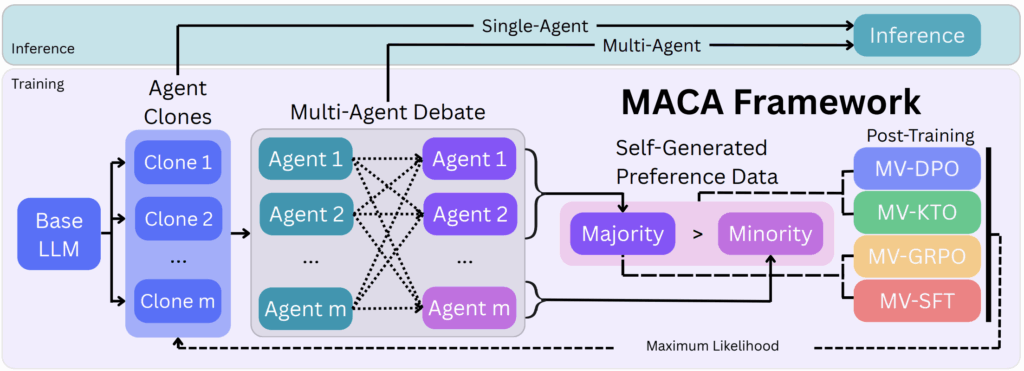
  • Internalizing Self-Consistency in LanguageModels: Multi-Agent Consensus Alignment

    Multi-Agent Consensus Alignment

    This paper addresses the evolving landscape of multi-agent reinforcement learning (MARL), focusing on the challenges and methodologies pertinent to cooperative and competitive agent interactions in complex environments. It provides a comprehensive survey of current approaches in MARL, highlighting key challenges such as non-stationarity, scalability, and communication among agents. The authors also discuss methodologies that have been proposed to overcome these challenges and point out emerging trends and future directions in this rapidly growing field.

    Introduction to Multi-Agent Reinforcement Learning

    Multi-agent reinforcement learning involves multiple autonomous agents learning to make decisions through interactions with the environment and each other. Unlike single-agent reinforcement learning, MARL systems must handle the complexity arising from interactions between agents, which can be cooperative, competitive, or mixed. The dynamic nature of other learning agents results in a non-stationary environment from each agent’s perspective, complicating the learning process. The paper stresses the importance of MARL due to its applications in robotics, autonomous driving, distributed control, and game theory.

    Major Challenges in MARL

    The paper identifies several critical challenges in MARL:

    • Non-Stationarity: Since all agents learn concurrently, the environment’s dynamics keep changing, making it hard for any single agent to stabilize its learning.
    • Scalability: The state and action spaces grow exponentially with the number of agents, posing significant computational and learning difficulties.
    • Partial Observability: Agents often have limited and local observations, which restrict their ability to fully understand the global state.
    • Credit Assignment: In cooperative settings, it is challenging to attribute overall team rewards to individual agents’ actions effectively.
    • Communication: Enabling effective and efficient communication protocols between agents is vital but non-trivial.

    Approaches and Frameworks in MARL

    The paper categorizes MARL methods primarily into three frameworks:

    1. Independent Learners: Agents learn independently using single-agent reinforcement learning algorithms while treating other agents as part of the environment. This approach is simple but often ineffective due to non-stationarity.
    2. Centralized Training with Decentralized Execution (CTDE): This popular paradigm trains agents with access to global information or shared parameters but executes policies independently based on local observations. It balances training efficiency and realistic execution constraints.
    3. Fully Centralized Approaches: These methods treat all agents as parts of one joint policy, optimizing over the combined action space. While theoretically optimal, these approaches struggle with scalability.

    Communication and Coordination Techniques

    Effective coordination and communication are imperative for MARL success. Techniques surveyed include:

    • Explicit Communication Protocols: Agents learn messages to exchange during training to improve coordination.
    • Implicit Communication: Coordination arises naturally through shared environments or value functions without explicit message passing.
    • Graph Neural Networks (GNNs): GNNs model interactions between agents, allowing flexible and scalable communication architectures suited for dynamic multi-agent systems.

    Recent Advances and Trends

    The paper highlights the integration of deep learning with MARL, enabling agents to handle high-dimensional sensory inputs and complex decision-making tasks. The use of attention mechanisms and transformer models for adaptive communication also shows promising results. Furthermore, adversarial training approaches are gaining traction in mixed cooperative-competitive environments to improve robustness and generalization.

    Applications and Use Cases

    MARL’s versatility is demonstrated in several domains:

    • Robotics: Multi-robot systems collaboratively performing tasks such as search and rescue, manipulation, and navigation.
    • Autonomous Vehicles: Coordination among autonomous cars to optimize traffic flow and safety.
    • Resource Management: Distributed control in wireless networks and energy grids.
    • Games: Complex strategic games like StarCraft II and Dota 2 serve as benchmarks for MARL algorithms.

    Open Problems and Future Directions

    The authors conclude by discussing open problems in MARL, including:

    • Scalability: Developing methods that effectively scale to large numbers of agents remains a core challenge.
    • Interpretability and Safety: Understanding learned policies and ensuring safe behaviors in real-world deployments are important.
    • Transfer Learning and Generalization: Improving agents’ ability to generalize to new tasks and environments should be prioritized.
    • Human-AI Collaboration: Integrating human knowledge and preferences with MARL systems is an emerging research frontier.

    Paper: https://arxiv.org/pdf/2509.15172

    Stay tuned for more insights into how AI is reshaping creativity and communication through multimodal learning.

  • Revolutionizing Text-to-Image Generation with Multimodal Instruction Tuning

    Revolutionizing Text-to-Image Generation with Multimodal Instruction Tuning
    Revolutionizing Text-to-Image Generation with Multimodal Instruction Tuning

    Text-to-image generation has become one of the most exciting frontiers in artificial intelligence, enabling the creation of vivid and detailed images from simple textual descriptions. While models like DALL·E, Stable Diffusion, and Imagen have made remarkable progress, challenges remain in making these systems more controllable, versatile, and aligned with user intent.

    A recent paper titled “Multimodal Instruction Tuning for Text-to-Image Generation” (arXiv:2506.09999) introduces a novel approach that significantly enhances text-to-image models by teaching them to follow multimodal instructions—combining text with visual inputs to guide image synthesis. This blog post unpacks the key ideas behind this approach, its benefits, and its potential to transform creative AI applications.

    The Limitations of Text-Only Prompts

    Most current text-to-image models rely solely on textual prompts to generate images. While effective, this approach has several drawbacks:

    • Ambiguity: Text can be vague or ambiguous, leading to outputs that don’t fully match user expectations.
    • Limited Detail Control: Users struggle to specify fine-grained aspects such as composition, style, or spatial arrangements.
    • Single-Modality Constraint: Relying only on text restricts the richness of instructions and limits creative flexibility.

    To overcome these challenges, integrating multimodal inputs—such as images, sketches, or layout hints—can provide richer guidance for image generation.

    What Is Multimodal Instruction Tuning?

    Multimodal instruction tuning involves training a text-to-image model to understand and follow instructions that combine multiple input types. For example, a user might provide:

    • A textual description like “A red sports car on a sunny day.”
    • A rough sketch or reference image indicating the desired layout or style.
    • Additional visual cues highlighting specific objects or colors.

    The model learns to fuse these diverse inputs, producing images that better align with the user’s intent.

    How Does the Proposed Method Work?

    The paper presents a framework extending diffusion-based text-to-image models by:

    • Unified Multimodal Encoder: Processing text and images jointly to create a shared representation space.
    • Instruction Tuning: Fine-tuning the model on a large dataset of paired multimodal instructions and target images.
    • Flexible Inputs: Allowing users to provide any combination of text and images during inference to guide generation.
    • Robustness: Ensuring the model gracefully handles missing or noisy modalities.

    Why Is This Approach a Game-Changer?

    • Greater Control: Users can specify detailed instructions beyond text, enabling precise control over image content and style.
    • Improved Alignment: Multimodal inputs help disambiguate textual instructions, resulting in more accurate and satisfying outputs.
    • Enhanced Creativity: Combining modalities unlocks new creative workflows, such as refining sketches or mixing styles.
    • Versatility: The model adapts to various use cases, from art and design to education and accessibility.

    Experimental Insights

    The researchers trained their model on a diverse dataset combining text, images, and target outputs. Key findings include:

    • High Fidelity: Generated images closely match multimodal instructions, demonstrating improved alignment compared to text-only baselines.
    • Diversity: The model produces a wider variety of images reflecting nuanced user inputs.
    • Graceful Degradation: Performance remains strong even when some input modalities are absent or imperfect.
    • User Preference: Human evaluators consistently favored multimodal-guided images over those generated from text alone.

    Real-World Applications

    Multimodal instruction tuning opens exciting possibilities across domains:

    • Creative Arts: Artists can provide sketches or style references alongside text to generate polished visuals.
    • Marketing: Teams can prototype campaigns with precise visual and textual guidance.
    • Education: Combining visual aids with descriptions enhances learning materials.
    • Accessibility: Users with limited verbal skills can supplement instructions with images or gestures.

    Challenges and Future Directions

    Despite its promise, multimodal instruction tuning faces hurdles:

    • Data Collection: Building large, high-quality multimodal instruction datasets is resource-intensive.
    • Model Complexity: Handling multiple modalities increases training and inference costs.
    • Generalization: Ensuring robust performance across diverse inputs and domains remains challenging.
    • User Interfaces: Designing intuitive tools for multimodal input is crucial for adoption.

    Future research may explore:

    • Self-supervised learning to reduce data needs.
    • Efficient architectures for multimodal fusion.
    • Extending to audio, video, and other modalities.
    • Interactive systems for real-time multimodal guidance.

    Conclusion: Toward Smarter, More Expressive AI Image Generation

    Multimodal instruction tuning marks a significant advance in making text-to-image models more controllable, expressive, and user-friendly. By teaching AI to integrate text and visual inputs, this approach unlocks richer creative possibilities and closer alignment with human intent.

    As these techniques mature, AI-generated imagery will become more precise, diverse, and accessible—empowering creators, educators, and users worldwide to bring their visions to life like never before.

    Paper: https://arxiv.org/pdf/2506.09999

    Stay tuned for more insights into how AI is reshaping creativity and communication through multimodal learning.

  • Enhancing Individual Spatiotemporal Activity Generation with MCP-Enhanced Chain-of-Thought Large Language Models

    Enhancing Individual Spatiotemporal Activity Generation with MCP-Enhanced Chain-of-Thought Large Language Models
    Enhancing Individual Spatiotemporal Activity Generation with MCP-Enhanced Chain-of-Thought Large Language Models

    Modeling and generating realistic human activity patterns over space and time is a crucial challenge in fields ranging from urban planning and public health to autonomous systems and social science. Traditional approaches often rely on handcrafted rules or limited datasets, which restrict their ability to capture the complexity and variability of individual behaviors.

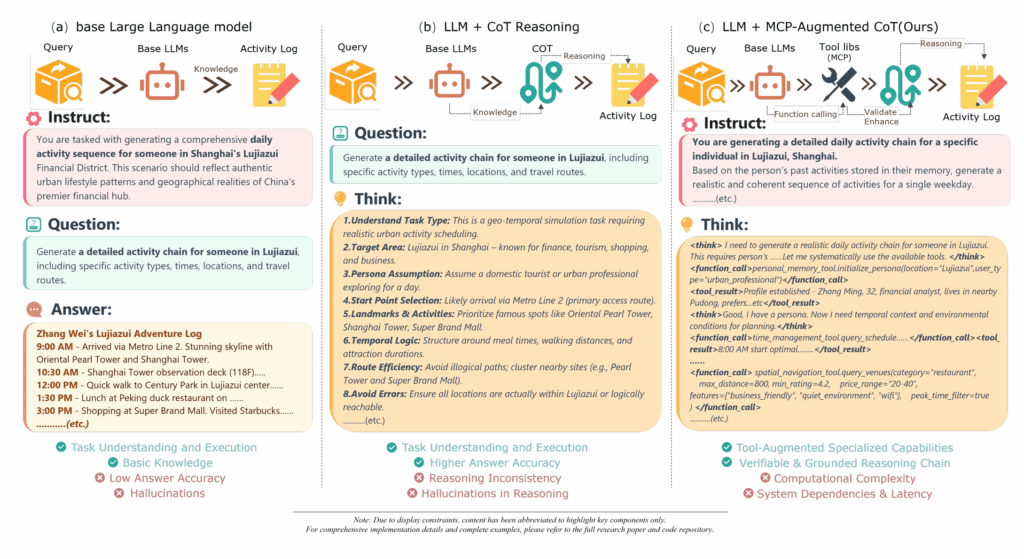
    A recent study titled “A Study on Individual Spatiotemporal Activity Generation Method Using MCP-Enhanced Chain-of-Thought Large Language Models” proposes a novel framework that leverages the reasoning capabilities of Large Language Models (LLMs) enhanced with a Model Context Protocol (MCP) and chain-of-thought (CoT) prompting to generate detailed, realistic spatiotemporal activity sequences for individuals.

    In this blog post, we’ll explore the key ideas behind this approach, its advantages, and potential applications.

    The Challenge: Realistic Spatiotemporal Activity Generation

    Generating individual activity sequences that reflect realistic patterns in both space and time is challenging because:

    • Complex dependencies: Human activities depend on various factors such as time of day, location context, personal preferences, and social interactions.
    • Long-range correlations: Activities are not isolated; they follow routines and habits that span hours or days.
    • Data scarcity: Detailed labeled data capturing full activity trajectories is often limited or unavailable.
    • Modeling flexibility: Traditional statistical or rule-based models struggle to generalize across diverse individuals and scenarios.

    Leveraging Large Language Models with Chain-of-Thought Reasoning

    Large Language Models like GPT-4 have shown remarkable ability to perform complex reasoning when guided with chain-of-thought (CoT) prompting, which encourages the model to generate intermediate reasoning steps before producing the final output.

    However, directly applying LLMs to spatiotemporal activity generation is non-trivial because:

    • The model must handle structured spatial and temporal information.
    • It needs to maintain consistency across multiple time steps.
    • It should incorporate contextual knowledge about locations and activities.

    Introducing Model Context Protocol (MCP)

    To address these challenges, the authors propose integrating a Model Context Protocol (MCP) with CoT prompting. MCP is a structured framework that guides the LLM to:

    • Understand and maintain context: MCP encodes spatial, temporal, and personal context in a standardized format.
    • Generate stepwise reasoning: The model produces detailed intermediate steps reflecting the decision process behind activity choices.
    • Ensure consistency: By formalizing context and reasoning, MCP helps maintain coherent activity sequences over time.

    The Proposed Framework: MCP-Enhanced CoT LLMs for Activity Generation

    The framework operates as follows:

    1. Context Encoding: The individual’s current spatiotemporal state and relevant environmental information are encoded using MCP.
    2. Chain-of-Thought Prompting: The LLM is prompted to reason through activity decisions step-by-step, considering constraints and preferences.
    3. Activity Sequence Generation: The model outputs a sequence of activities with associated locations and timestamps, reflecting realistic behavior.
    4. Iterative Refinement: The process can be repeated or conditioned on previous outputs to generate longer or more complex activity patterns.

    Advantages of This Approach

    • Flexibility: The LLM can generate diverse activity sequences without requiring extensive domain-specific rules.
    • Interpretability: Chain-of-thought reasoning provides insight into the decision-making process behind activity choices.
    • Context-awareness: MCP ensures that spatial and temporal contexts are explicitly considered, improving realism.
    • Scalability: The method can be adapted to different individuals and environments by modifying context inputs.

    Experimental Validation

    The study evaluates the framework on synthetic and real-world-inspired scenarios, demonstrating that:

    • The generated activity sequences exhibit realistic temporal rhythms and spatial patterns.
    • The model successfully captures individual variability and routine behaviors.
    • MCP-enhanced CoT prompting outperforms baseline methods that lack structured context or reasoning steps.

    Potential Applications

    • Urban Planning: Simulating realistic human movement patterns to optimize transportation and infrastructure.
    • Public Health: Modeling activity patterns to study disease spread or design interventions.
    • Autonomous Systems: Enhancing prediction of human behavior for safer navigation and interaction.
    • Social Science Research: Understanding behavioral dynamics and lifestyle patterns.

    Future Directions

    The authors suggest several promising avenues for further research:

    • Integrating multimodal data (e.g., sensor readings, maps) to enrich context.
    • Extending the framework to group or crowd activity generation.
    • Combining with reinforcement learning to optimize activity sequences for specific objectives.
    • Applying to real-time activity prediction and anomaly detection.

    Conclusion

    This study showcases the power of combining Large Language Models with structured context protocols and chain-of-thought reasoning to generate detailed, realistic individual spatiotemporal activity sequences. By formalizing context and guiding reasoning, the MCP-enhanced CoT framework opens new possibilities for modeling complex human behaviors with flexibility and interpretability.

    As AI continues to advance, such innovative approaches will be key to bridging the gap between raw data and meaningful, actionable insights into human activity patterns.

    Paper: https://arxiv.org/pdf/2506.10853

    Stay tuned for more insights into how AI is transforming our understanding and simulation of human behavior in space and time.

  • Data-Driven Diagnosis for Large Cyber-Physical Systems with Minimal Prior Information

    Data-Driven Diagnosis for Large Cyber-Physical Systems with Minimal Prior Information
    Data-Driven Diagnosis for Large Cyber-Physical Systems with Minimal Prior Information

    Diagnosing faults in large and complex Cyber-Physical Systems (CPSs) like manufacturing plants, water treatment facilities, or space stations is notoriously challenging. Traditional diagnostic methods often require detailed system models or extensive labeled fault data, which are costly and sometimes impossible to obtain. A recent study by Steude et al. proposes a novel data-driven diagnostic approach that works effectively with minimal prior knowledge, relying only on basic subsystem relationships and nominal operation data.

    In this blog post, we’ll break down their innovative methodology, key insights, and experimental results, highlighting how this approach can transform fault diagnosis in large CPSs.

    The Challenge of Diagnosing Large CPSs

    • Complexity and scale: Modern CPSs consist of numerous interconnected subsystems, sensors, and actuators generating vast amounts of data.
    • Limited prior knowledge: Detailed system models or comprehensive fault labels are often unavailable or incomplete.
    • Traditional methods’ limitations:
      • Supervised learning requires labeled faults, which are expensive and error-prone to obtain.
      • Symbolic and model-based diagnosis demands precise system models, which are hard to build and maintain.
      • Existing approaches struggle to detect unforeseen or novel faults.

    Research Questions Guiding the Study

    The authors focus on two main questions:

    • RQ1: Can we generate meaningful symptoms for diagnosis by enhancing data-driven anomaly detection with minimal prior knowledge (like subsystem structure)?
    • RQ2: Can we identify the faulty subsystems causing system failures using these symptoms without heavy modeling efforts?

    Core Idea: Leveraging Minimal Prior Knowledge

    The approach requires only three inputs:

    1. Nominal operation data: Time series sensor measurements during normal system behavior.
    2. Subsystem-signals map: A mapping that associates each subsystem with its relevant sensors.
    3. Causal subsystem graph: A directed graph representing causal fault propagation paths between subsystems (e.g., a faulty pump causing anomalies in connected valves).

    This minimal prior knowledge is often available or can be derived with limited effort in practice.

    Method Overview

    The diagnostic process consists of three main phases:

    1. Knowledge Formalization

    • Extract the causal subsystem graph from system documentation or expert knowledge.
    • Map sensor signals to corresponding subsystems, establishing the subsystem-signals map.

    2. Model Training

    • Train a neural network-based symptom generator that performs anomaly detection at the subsystem level by analyzing sensor data.
    • Fit a residual binarizer model per subsystem to convert continuous anomaly scores into binary symptoms indicating abnormal behavior.

    3. Model Inference and Diagnosis

    • Continuously monitor system data streams.
    • Generate subsystem-level health states (symptoms) using the trained neural network and binarizer.
    • Run a graph-based diagnosis algorithm that uses the causal subsystem graph and detected symptoms to identify the minimal set of causal subsystems responsible for the observed anomalies.

    Why Subsystem-Level Diagnosis?

    • Bridging granularity: Instead of analyzing individual sensors (too fine-grained) or the entire system (too coarse), focusing on subsystems balances interpretability and scalability.
    • Modular anomaly detection: Neural networks specialized per subsystem can better capture local patterns.
    • Causal reasoning: The causal subsystem graph enables tracing fault propagation paths, improving root cause identification.

    Key Contributions

    • Demonstrated that structure-informed deep learning models can generate meaningful symptoms at the subsystem level.
    • Developed a novel graph diagnosis algorithm leveraging minimal causal information to pinpoint root causes efficiently.
    • Provided a systematic evaluation on both simulated and real-world datasets, showing strong diagnostic performance with minimal prior knowledge.

    Experimental Highlights

    Simulated Hydraulic System

    • The system comprises subsystems like pumps, valves, tanks, and cylinders interconnected causally.
    • Results showed that the true causal subsystem was included in the diagnosis set in 82% of cases.
    • The search space for diagnosis was effectively reduced in 73% of scenarios, improving efficiency.

    Real-World Secure Water Treatment Dataset

    • The approach successfully identified faulty subsystems in a complex industrial water treatment setting.
    • Demonstrated practical applicability beyond simulations.

    Related Research Landscape

    • Anomaly Detection: Deep learning models (transformers, graph neural networks, autoencoders) excel at detecting deviations but often lack root cause analysis.
    • Fault Diagnosis: Traditional methods rely on detailed models or labeled faults, limiting scalability.
    • Causality and Fault Propagation: Using causal graphs to model fault propagation is a powerful concept but often requires detailed system knowledge.

    This work uniquely combines data-driven anomaly detection with minimal causal information to enable scalable, practical diagnosis.

    Why This Matters

    • Minimal prior knowledge: Reduces dependency on costly system modeling or fault labeling.
    • Scalability: Suitable for large, complex CPSs with many sensors and subsystems.
    • Practicality: Uses information commonly available in industrial settings.
    • Improved diagnostics: Enables faster and more accurate root cause identification, aiding maintenance and safety.

    Future Directions

    • Extending to more diverse CPS domains with varying complexity.
    • Integrating online learning for adaptive diagnosis in evolving systems.
    • Enhancing causal graph extraction methods using data-driven or language model techniques.
    • Combining with explainability tools to improve human trust and understanding.

    Summary

    Steude et al.’s novel approach presents a promising path toward effective diagnosis in large cyber-physical systems with minimal prior knowledge. By combining subsystem-level anomaly detection with a causal graph-based diagnosis algorithm, their method balances accuracy, efficiency, and practicality. This work opens new opportunities for deploying intelligent diagnostic systems in real-world industrial environments where detailed system models or labeled faults are scarce.

    Paper: https://arxiv.org/pdf/2506.10613

    If you’re interested in the intersection of AI, industrial automation, and fault diagnosis, this research highlights how data-driven methods can overcome longstanding challenges with minimal manual effort.