Blog AI Frontiers

  • Unlocking the Power of Text-to-Image Models with Multimodal Instruction Tuning

    Unlocking the Power of Text-to-Image Models with Multimodal Instruction Tuning
    Unlocking the Power of Text-to-Image Models with Multimodal Instruction Tuning

    Text-to-image generation has become one of the most captivating areas in artificial intelligence, enabling machines to create vivid, detailed images from simple text prompts. Models like DALL·E, Stable Diffusion, and Imagen have amazed us with their ability to translate words into stunning visuals. Yet, despite these advances, there remain challenges in making these models truly versatile, controllable, and aligned with user intentions.

    A recent research paper titled “Multimodal Instruction Tuning for Text-to-Image Generation” introduces a novel approach to enhance text-to-image models by teaching them to follow multimodal instructions. In this blog post, we’ll explore what multimodal instruction tuning is, why it matters, and how it can push the boundaries of AI creativity and usability.

    The Challenge: From Text Prompts to Rich, Controllable Images

    Current text-to-image models primarily rely on textual prompts to generate images. While powerful, this approach has some limitations:

    • Ambiguity and Vagueness: Text alone can be ambiguous, leading to outputs that don’t fully match user expectations.
    • Limited Control: Users have little ability to specify fine-grained details, such as layout, style, or object relationships.
    • Single-Modal Input: Relying solely on text restricts the richness of instructions that can be provided.

    To address these issues, researchers are exploring ways to incorporate multimodal inputs—combining text with images, sketches, or other visual cues—to guide generation more precisely.

    What Is Multimodal Instruction Tuning?

    Multimodal instruction tuning is a training strategy where a text-to-image model learns to follow instructions that combine multiple modalities. For example, a user might provide:

    • A textual description (“A red sports car on a sunny day”)
    • An example image or sketch showing the desired style or composition
    • Additional visual cues highlighting specific objects or layouts

    The model is trained on datasets containing paired multimodal instructions and corresponding images, learning to integrate these diverse inputs into coherent, high-quality outputs.

    How Does This Approach Work?

    The paper proposes a framework that extends existing diffusion-based text-to-image models by:

    • Incorporating Multimodal Inputs: The model accepts both text and image-based instructions as input embeddings.
    • Unified Encoder: A shared encoder processes different modalities, aligning them into a common representation space.
    • Instruction Tuning: The model is fine-tuned on a large collection of multimodal instruction-image pairs, teaching it to follow complex, multimodal commands.
    • Flexible Generation: At inference time, users can provide any combination of text and images to guide image synthesis.

    Why Is Multimodal Instruction Tuning a Game-Changer?

    • Enhanced Control: Users can specify detailed instructions beyond what text alone can convey, enabling precise control over image content and style.
    • Improved Alignment: The model better understands user intent by integrating complementary information from multiple modalities.
    • Versatility: The approach supports a wide range of use cases, from creative design and advertising to education and accessibility.
    • Reduced Ambiguity: Visual cues help disambiguate textual instructions, leading to more accurate and satisfying outputs.

    Experimental Results: Proof of Concept

    The researchers trained their model on a diverse dataset combining text descriptions, reference images, and target outputs. Key findings include:

    • Higher Fidelity: Generated images closely match multimodal instructions, demonstrating improved alignment.
    • Better Diversity: The model produces a wider variety of images reflecting nuanced user inputs.
    • Robustness: It performs well even when some modalities are missing or noisy, gracefully degrading performance.
    • User Studies: Participants preferred multimodal-guided generations over text-only baselines for clarity and satisfaction.

    Real-World Applications

    Multimodal instruction tuning opens up exciting possibilities:

    • Creative Industries: Artists and designers can sketch rough drafts or provide style references alongside text to generate polished visuals.
    • Marketing and Advertising: Teams can rapidly prototype campaigns with precise visual and textual guidance.
    • Education: Visual aids combined with descriptions can help create engaging learning materials.
    • Accessibility: Users with limited ability to describe scenes verbally can supplement with images or gestures.

    Challenges and Future Directions

    While promising, multimodal instruction tuning also presents challenges:

    • Data Collection: Building large, high-quality multimodal instruction datasets is resource-intensive.
    • Model Complexity: Integrating multiple modalities increases model size and training costs.
    • Generalization: Ensuring the model generalizes well across diverse inputs and domains remains an open problem.
    • User Interface Design: Developing intuitive tools for users to provide multimodal instructions is crucial for adoption.

    Future research may explore:

    • Leveraging self-supervised learning to reduce data requirements.
    • Optimizing architectures for efficiency and scalability.
    • Extending to other modalities like audio or video.
    • Creating interactive interfaces for real-time multimodal guidance.

    Conclusion: Toward Smarter, More Expressive AI Image Generation

    Multimodal instruction tuning represents a significant step forward in making text-to-image models more controllable, expressive, and user-friendly. By teaching AI to understand and integrate multiple forms of input, we unlock richer creative possibilities and closer alignment with human intent.

    As these techniques mature, we can expect AI-generated imagery to become more precise, diverse, and accessible—empowering creators, educators, and users worldwide to bring their visions to life like never before.

    Paper: https://arxiv.org/pdf/2506.10773

    Stay tuned for more updates on the cutting edge of AI creativity and how multimodal learning is reshaping the future of image generation.

  • Building the Web for Agents, Not Agents for the Web: A New Paradigm for AI Web Interaction

    Build the web for agents, not agents for the web
    Build the web for agents, not agents for the web

    The rise of Large Language Models (LLMs) and their multimodal counterparts has sparked a surge of interest in web agents—AI systems capable of autonomously navigating websites and completing complex tasks like booking flights, shopping, or managing emails. While this technology promises to revolutionize how we interact with the web, current approaches face fundamental challenges. Why? Because the web was designed for humans, not AI agents.

    In this blog post, we explore a visionary perspective from recent research advocating for a paradigm shift: instead of forcing AI agents to adapt to human-centric web interfaces, we should build the web specifically for agents. This new concept, called the Agentic Web Interface (AWI), aims to create safer, more efficient, and standardized environments tailored to AI capabilities.

    The Current Landscape: Web Agents Struggle with Human-Centric Interfaces

    Web agents today are designed to operate within the existing web ecosystem, which means interacting with:

    • Browser UIs: Agents process screenshots, Document Object Model (DOM) trees, or accessibility trees to understand web pages.
    • Web APIs: Some agents bypass the UI by calling APIs designed for developers rather than agents.

    Challenges Faced by Browser-Based Agents

    • Complex and Inefficient Representations:
      • Screenshots are visually rich but incomplete (hidden menus or dynamic content are missed).
      • DOM trees contain detailed page structure but are massive and noisy, often exceeding millions of tokens, making processing expensive and slow.
    • Resource Strain and Defensive Measures:
      • Automated browsing at scale can overload websites, leading to performance degradation for human users.
      • Websites respond with defenses like CAPTCHAs, which sometimes block legitimate agent use and create accessibility issues.
    • Safety and Privacy Risks:
      • Agents operating within browsers may access sensitive user data (passwords, payment info), raising concerns over misuse or accidental harm.

    Limitations of API-Based Agents

    • Narrow Action Space:
      APIs offer limited functionality compared to full UI interactions, often lacking stateful controls like sorting or filtering.
    • Developer-Centric Design:
      APIs are built for human developers, not autonomous agents, and may throttle or deny excessive requests.
    • Fallback to UI:
      When APIs cannot fulfill a task, agents must revert to interacting with the browser UI, inheriting its limitations.

    The Core Insight: The Web Is Built for Humans, Not Agents

    The fundamental problem is that web interfaces were designed for human users, with visual layouts, interactive elements, and workflows optimized for human cognition and behavior. AI agents, however, process information very differently and require interfaces that reflect their unique needs.

    Trying to force agents to operate within human-centric environments leads to inefficiency, high computational costs, and safety vulnerabilities.

    Introducing the Agentic Web Interface (AWI)

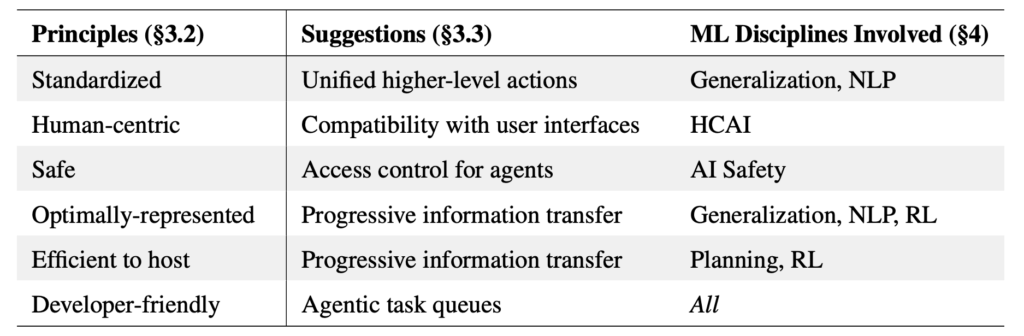
    The research proposes a bold new concept: designing web interfaces specifically for AI agents. The AWI would be a new layer or paradigm where websites expose information and controls in a way that is:

    • Efficient: Minimal and relevant information, avoiding the noise and overhead of full DOM trees or screenshots.
    • Safe: Built-in safeguards to protect user data and prevent malicious actions.
    • Standardized: Consistent formats and protocols to allow agents to generalize across different sites.
    • Transparent: Clear and auditable agent actions to build trust.
    • Expressive: Rich enough to support complex tasks and stateful interactions.
    • Collaborative: Designed with input from AI researchers, developers, and stakeholders to balance usability and security.

    Why AWI Matters: Benefits for All Stakeholders

    • For AI Agents:
      Agents can navigate and interact with websites more reliably and efficiently, reducing computational overhead and improving task success rates.
    • For Website Operators:
      Reduced server load and better control over agent behavior, minimizing the need for aggressive defenses like CAPTCHAs.
    • For Users:
      Safer interactions with AI agents that respect privacy and security, enabling trustworthy automation of web tasks.
    • For the AI Community:
      A standardized platform to innovate and build more capable, generalizable web agents.

    What Would AWI Look Like?

    While the paper does not prescribe a specific implementation, it envisions an interface that:

    • Provides structured, concise representations of page content tailored for agent consumption.
    • Supports declarative actions that agents can perform, such as clicking buttons, filling forms, or navigating pages, in a way that is unambiguous and verifiable.
    • Includes mechanisms for permissioning and auditing to ensure agents act within authorized boundaries.
    • Enables incremental updates to the interface as the page state changes, allowing agents to maintain situational awareness without reprocessing entire pages.

    The Road Ahead: Collaborative Effort Needed

    Designing and deploying AWIs will require:

    • Interdisciplinary collaboration: Web developers, AI researchers, security experts, and regulators must work together.
    • Community standards: Similar to how HTML and HTTP standardized web content and communication, AWI standards must emerge to enable broad adoption.
    • Iterative design and evaluation: Prototypes and experiments will be essential to balance agent needs with user safety and privacy.

    Conclusion: Building the Web for the Future of AI Agents

    The vision of the Agentic Web Interface challenges the status quo by asking us to rethink how web interactions are designed—not just for humans, but for intelligent agents that will increasingly automate our digital lives.

    By building the web for agents, we can unlock safer, more efficient, and more powerful AI-driven automation, benefiting users, developers, and the broader AI ecosystem.

    This paradigm shift calls for collective action from the machine learning community and beyond to create the next generation of web interfaces—ones that truly empower AI agents to thrive.

    Paper: https://arxiv.org/pdf/2506.10953

    If you’re interested in the future of AI and web interaction, stay tuned for more insights as researchers and developers explore this exciting frontier.

  • Self-Adapting Language Models: Teaching AI to Learn and Improve Itself

    Self-Adapting Language Models
    Self-Adapting Language Models

    Large language models (LLMs) like GPT and others have transformed natural language processing with their impressive ability to understand and generate human-like text. However, these models are typically static once trained—they don’t adapt their internal knowledge or behavior dynamically when faced with new tasks or data. What if these powerful models could teach themselves to improve, much like humans do when they revise notes or study smarter?

    A recent breakthrough from researchers at MIT introduces Self-Adapting Language Models (SEAL), a novel framework that enables LLMs to self-adapt by generating their own fine-tuning data and update instructions. This blog post explores how SEAL works, why it’s a game-changer for AI, and what it means for the future of language models.

    The Problem: Static Models in a Changing World

    • LLMs are powerful but fixed: Once trained, their weights remain static during deployment.
    • Adapting to new tasks or information requires external fine-tuning: This process depends on curated data and manual intervention.
    • Current adaptation methods treat training data “as-is”: Models consume new data directly, without transforming or restructuring it for better learning.
    • Humans learn differently: We often rewrite, summarize, or reorganize information to understand and remember it better.

    SEAL’s Vision: Models That Learn to Learn

    SEAL is inspired by how humans assimilate new knowledge. For example, a student preparing for an exam doesn’t just reread textbooks; they rewrite notes, create diagrams, or generate practice questions to deepen understanding. Similarly, SEAL enables language models to:

    • Generate their own training data (“self-edits”) tailored to the task.
    • Specify how to update their weights, including optimization parameters.
    • Use reinforcement learning (RL) to improve these self-edits based on downstream task performance.
    • Perform persistent weight updates, enabling lasting adaptation.

    How Does SEAL Work? A Two-Loop Learning Process

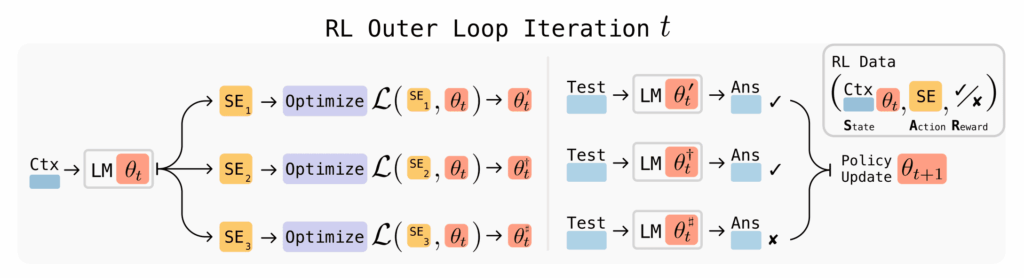
    SEAL’s training involves two nested loops:

    1. Outer Loop: Reinforcement Learning for Self-Edit Generation

    • The model receives a task context (e.g., a passage of text or few-shot examples).
    • It generates self-edits—natural language instructions that define synthetic training data and update strategies.
    • These self-edits act as actions in an RL framework.
    • The model’s updated performance on the task (after applying the self-edits) serves as a reward signal.
    • The model’s policy for generating self-edits is updated to maximize expected rewards.

    2. Inner Loop: Applying Self-Edits to Update Weights

    • The generated self-edits are used to fine-tune the model via supervised learning.
    • This results in new model parameters that hopefully perform better on the target task.
    • The updated model is then evaluated to provide feedback for the outer loop.

    Why Is SEAL Different and Important?

    • Self-Directed Adaptation: Unlike prior approaches that rely on separate modules or external data, SEAL uses the model’s own generations to drive adaptation.
    • Flexible and General: Self-edits can take many forms—rewriting passages, generating question-answer pairs, or specifying optimization settings.
    • Reinforcement Learning Optimizes Utility: The model learns to produce self-edits that actually improve downstream performance, not just plausible text.
    • Persistent Updates: Adaptation is not temporary; the model’s weights are updated, enabling lasting improvements.

    Real-World Applications and Results

    SEAL was tested on two key tasks:

    1. Knowledge Incorporation

    • Instead of fine-tuning directly on raw passages, SEAL generates synthetic data (self-edits) to train on.
    • This approach improved question-answering accuracy on a no-passage-in-context variant of the SQuAD dataset from 33.5% to 47.0%.
    • Notably, SEAL’s self-generated data outperformed synthetic data created by GPT-4, highlighting the advantage of task-specific, optimized self-edits.

    2. Few-Shot Learning

    • SEAL autonomously selects synthetic data augmentations and optimization hyperparameters (like learning rate and training epochs).
    • This automatic configuration outperformed standard in-context learning and naive self-editing without reinforcement learning.
    • The model effectively learned how to learn from few examples, improving generalization.

    How Does SEAL Fit Into the Bigger AI Landscape?

    • Synthetic Data Generation: SEAL builds on methods that create artificial training data but uniquely optimizes this data generation for maximal learning benefit.
    • Knowledge Updating: SEAL advances techniques that inject factual knowledge into LLMs through weight updates, but with a learned, adaptive strategy.
    • Test-Time Training: SEAL incorporates ideas from test-time training, adapting weights based on current inputs, but extends this with reinforcement learning.
    • Meta-Learning: SEAL embodies meta-learning by learning how to generate effective training data and updates, essentially learning to learn.
    • Self-Improvement: SEAL represents a scalable path for models to improve themselves using external data and internal feedback loops.

    Challenges and Future Directions

    • Training Stability: Reinforcement learning with model-generated data is complex and can be unstable; SEAL uses a method called ReSTEM (filtered behavior cloning) to stabilize training.
    • Generalization: While promising, further work is needed to apply SEAL to a broader range of tasks and larger models.
    • Cold-Start Learning: Future research may explore how models can discover optimal self-edit formats without initial prompt guidance.
    • Integration with Other Techniques: Combining SEAL with other adaptation and compression methods could yield even more efficient and powerful systems.

    Why You Should Care

    • SEAL pushes AI closer to human-like learning, where models don’t just passively consume data but actively restructure and optimize their learning process.
    • This could lead to language models that continuously improve themselves in deployment, adapting to new knowledge and tasks without costly retraining.
    • For developers and researchers, SEAL offers a new paradigm for building adaptable, efficient, and autonomous AI systems.

    Final Thoughts

    Self-Adapting Language Models (SEAL) open exciting possibilities for the future of AI. By teaching models to generate their own training data and fine-tuning instructions, SEAL enables them to self-improve in a principled, reinforcement learning-driven way. This innovation marks a significant step toward truly autonomous AI systems that learn how to learn, adapt, and evolve over time.

    For those interested in the cutting edge of machine learning, SEAL is a fascinating development worth following closely.

    Explore more about SEAL and see the code at the project website: https://jyopari.github.io/posts/seal

  • Enhancing Text-to-Image Diffusion Models with Efficient Token Pruning

    Enhancing Text-to-Image Diffusion Models with Efficient Token Pruning
    Enhancing Text-to-Image Diffusion Models with Efficient Token Pruning

    Text-to-image diffusion models have revolutionized the way AI generates images from textual descriptions, enabling stunning visual creativity. However, these models often come with hefty computational costs, limiting their efficiency and accessibility. A recent research paper introduces an innovative technique called Token Pruning that streamlines these models by intelligently reducing the number of tokens processed during image generation—without sacrificing quality. In this blog post, we’ll explore how token pruning works, why it matters, and what benefits it brings to the future of AI-powered image synthesis.

    The Challenge: Balancing Quality and Efficiency in Diffusion Models

    Diffusion models generate images by gradually transforming random noise into coherent visuals, guided by text prompts. The process involves complex neural networks that interpret the text and progressively refine the image. While powerful, these models face two main challenges:

    • High Computational Demand: Processing every token (word or subword) in a text prompt through multiple layers requires significant memory and compute resources.
    • Latency Issues: The extensive computation leads to slower image generation, which can hinder real-time applications or deployment on resource-constrained devices.

    Reducing the number of tokens processed could speed up inference, but naively dropping tokens risks losing important semantic information, degrading image quality.

    What Is Token Pruning?

    Token pruning is a technique that dynamically identifies and removes less important tokens during the forward pass of the diffusion model. Instead of treating all tokens equally, the model learns to focus on the most relevant parts of the text prompt at each stage of image generation.

    Key ideas behind token pruning include:

    • Dynamic Selection: Tokens are pruned based on their contribution to the current generation step, allowing the model to adaptively focus on critical information.
    • Layer-wise Pruning: Pruning decisions occur at multiple layers, progressively reducing token count as the model refines the image.
    • Preserving Semantics: The method ensures that essential semantic content is retained, maintaining image fidelity.

    How Does Token Pruning Work?

    The proposed approach integrates token pruning into the diffusion model’s architecture with the following components:

    • Importance Scoring: At each layer, tokens are assigned importance scores reflecting their relevance to the current generation task.
    • Pruning Mechanism: Tokens with low scores are pruned, reducing the computational load for subsequent layers.
    • Token Reweighting: Remaining tokens are reweighted to compensate for the pruned ones, preserving overall semantic balance.
    • End-to-End Training: The entire system is trained jointly, enabling the model to learn effective pruning strategies without manual intervention.

    Why Is This Breakthrough Important?

    Token pruning offers several compelling advantages for text-to-image diffusion models:

    • Reduced Computation: By processing fewer tokens, the model requires less memory and compute power.
    • Faster Inference: Pruning accelerates image generation, making diffusion models more practical for real-time or interactive applications.
    • Maintained Quality: Despite pruning, the approach preserves or even improves image quality by focusing on the most informative tokens.
    • Scalability: The method can be applied to various diffusion architectures and text encoders, enhancing flexibility.

    Real-World Benefits and Applications

    The efficiency gains from token pruning unlock new possibilities for AI-generated imagery:

    • Creative Tools: Artists and designers can enjoy faster iterations when generating visuals from text prompts.
    • Mobile and Edge Devices: Lightweight models enable deployment on smartphones and other devices with limited resources.
    • Interactive Experiences: Games, virtual reality, and augmented reality applications can integrate real-time text-to-image generation.
    • Cost Efficiency: Reduced computational demands lower cloud infrastructure costs for AI service providers.

    Summary of Key Contributions

    • Introduced a novel token pruning technique tailored for text-to-image diffusion models.
    • Developed a dynamic, layer-wise pruning strategy based on learned importance scores.
    • Demonstrated significant computational savings and faster inference without compromising image quality.
    • Validated the approach on standard benchmarks, showing competitive or superior performance.

    Looking Ahead: The Future of Efficient Image Generation

    Token pruning marks a significant step toward making powerful diffusion models more accessible and practical. As AI continues to evolve, combining such efficiency techniques with advances in model architecture and training will further democratize creative AI tools.

    Future research directions may include:

    • Extending pruning methods to other modalities like video or 3D generation.
    • Exploring adaptive pruning thresholds based on user preferences or hardware constraints.
    • Integrating token pruning with other compression and acceleration techniques.

    Final Thoughts

    The ability to generate high-quality images from text prompts is transforming creativity and communication. By intelligently pruning tokens, this new method makes diffusion models faster and more efficient—without sacrificing the rich detail and nuance that make AI-generated art so compelling.

    Whether you’re an AI researcher, developer, or enthusiast, token pruning offers exciting insights into how we can build smarter, leaner models that bring cutting-edge technology closer to everyday use.

    Stay tuned for more updates on innovations that push the boundaries of AI creativity and efficiency!

    Paper: https://arxiv.org/pdf/2506.10540

    If you enjoyed this deep dive into token pruning and diffusion models, follow our blog for more accessible explanations of the latest AI research breakthroughs.