Blog AI Frontiers

  • Learning Conditional Class Dependencies: A Breakthrough in Few-Shot Classification

    A Call for Collaborative Intelligence: Why
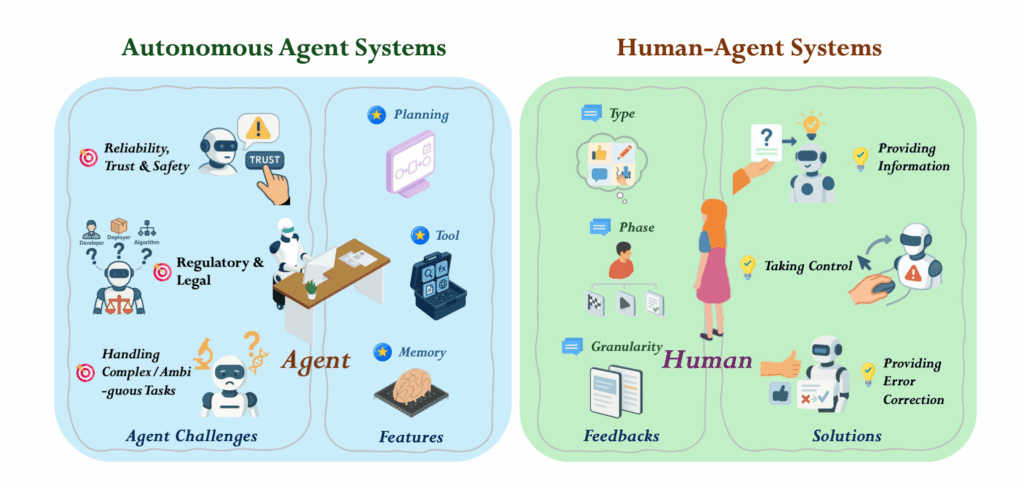
Human-Agent Systems Should Precede AI Autonomy
    A Call for Collaborative Intelligence: Why Human-Agent Systems Should Precede AI Autonomy

    Few-shot learning is one of the most exciting frontiers in artificial intelligence today. It aims to enable machines to recognize new classes or categories from just a handful of examples—much like humans do. However, teaching AI to learn effectively from such limited data remains a significant challenge. A recent research paper introduces a novel approach that leverages conditional class dependencies to dramatically improve few-shot classification. In this blog post, we’ll explore what this means, why it matters, and how it can transform AI’s ability to learn quickly and accurately.

    What Is Few-Shot Learning and Why Is It Hard?

    Traditional AI models rely heavily on large datasets to learn patterns and make predictions. For example, a model trained to recognize dog breeds might need thousands of labeled images for each breed. But in many real-world scenarios, collecting such extensive data is impractical or impossible.

    Few-shot learning addresses this by designing models that can generalize from just a few labeled examples per class. The goal is to mimic human learning efficiency, where a person can recognize a new object after seeing it only once or twice.

    Despite its promise, few-shot learning faces key challenges:

    • Data Scarcity: Few examples limit the model’s ability to capture the full range of variability within a class.
    • Class Similarity: Some categories are visually or semantically close, making it difficult to differentiate them with limited data.
    • Ignoring Class Relationships: Many existing methods treat each class independently, missing out on valuable contextual information.

    The Power of Conditional Class Dependencies

    Humans rarely consider categories in isolation. When identifying an object, we naturally use context and relationships between categories to guide our decision. For example, if you know an animal is a bird, it’s less likely to be a mammal.

    Conditional class dependencies refer to the relationships among classes that influence classification outcomes. In AI terms, this means the probability that a sample belongs to one class depends on the presence or absence of others.

    By explicitly modeling these dependencies, AI systems can make more informed predictions, especially when data is limited.

    Introducing a Novel Framework: Learning with Conditional Class Dependencies

    The recent research proposes a new framework that integrates conditional class dependencies into few-shot classification. Here’s how it works:

    Building a Class Dependency Graph

    Instead of treating classes as independent labels, the model constructs a graph where each node represents a class, and edges encode the dependencies or relationships between classes. This graph is learned dynamically during training, allowing the model to capture complex interactions among classes.

    Using Graph Neural Networks (GNNs) for Information Propagation

    Graph Neural Networks are powerful tools for learning on graph-structured data. In this framework, GNNs propagate information along the edges of the class dependency graph, enabling the model to refine its understanding of each class by considering related classes.

    Integrating with Few-Shot Learning

    When the model encounters new classes with only a few examples, it leverages the learned class dependency graph to make better predictions. By understanding how classes relate, the model can disambiguate confusing cases and improve accuracy.

    Why Does This Approach Matter?

    Incorporating conditional class dependencies brings several benefits:

    • Enhanced Accuracy: By considering class relationships, the model better distinguishes between similar classes.
    • Improved Generalization: The learned dependencies help the model adapt to new, unseen classes more effectively.
    • Human-Like Reasoning: Mimics the way humans use context and relationships to classify objects, especially when information is scarce.

    Real-World Applications

    This approach has broad implications across various domains:

    • Healthcare: Diagnosing diseases with overlapping symptoms can benefit from understanding dependencies between conditions.
    • Wildlife Conservation: Identifying rare species from limited sightings becomes more accurate by modeling species relationships.
    • Security: Rapidly recognizing new threats or objects with few examples is critical in surveillance.
    • Personalization: Enhancing recommendations by understanding how user preferences relate across categories.

    Experimental Evidence: Putting Theory into Practice

    The researchers evaluated their method on popular few-shot classification benchmarks and observed:

    • Consistent improvements over existing state-of-the-art models.
    • Better performance in scenarios involving visually or semantically similar classes.
    • Robustness to noisy or limited data samples.

    These results highlight the practical value of modeling conditional class dependencies in few-shot learning.

    The Bigger Picture: Towards Smarter, More Efficient AI

    This research aligns with a broader trend in AI towards models that learn more efficiently and reason more like humans. Key themes include:

    • Self-Supervised Learning: Leveraging unlabeled data and structural information.
    • Graph-Based Learning: Exploiting relationships and dependencies in data.
    • Explainability: Models that reason about class relationships offer better interpretability.

    Conclusion: A Step Forward in Few-Shot Learning

    Learning with conditional class dependencies marks a significant advance in few-shot classification. By explicitly modeling how classes relate, AI systems become better at making accurate predictions from limited data, generalizing to new classes, and mimicking human reasoning.

    As AI research continues to push boundaries, approaches like this will be crucial for building intelligent systems that learn quickly, adapt easily, and perform reliably in the real world.

    Paper: https://arxiv.org/pdf/2506.09420

    Stay tuned for more insights into cutting-edge AI research and how it shapes the future of technology.

  • Unlocking Smarter AI: How Learning Conditional Class Dependencies Boosts Few-Shot Classification

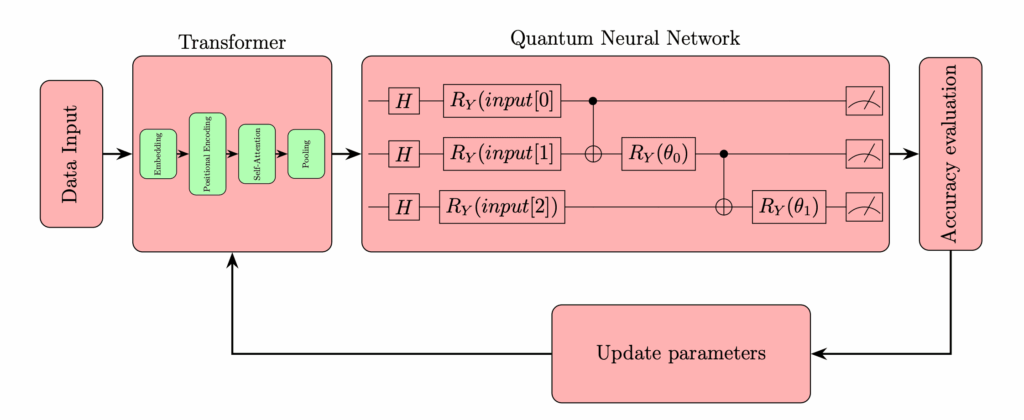
    Genetic Transformer-Assisted Quantum Neural
Networks for Optimal Circuit Design
    Genetic Transformer-Assisted Quantum Neural Networks for Optimal Circuit Design

    Imagine teaching a computer to recognize a new object after seeing just a handful of examples. This is the promise of few-shot learning, a rapidly growing area in artificial intelligence (AI) that aims to mimic human-like learning efficiency. But while humans can quickly grasp new concepts by understanding relationships and context, many AI models struggle when data is scarce.

    A recent research breakthrough proposes a clever way to help AI learn better from limited data by focusing on conditional class dependencies. Let’s dive into what this means, why it matters, and how it could revolutionize AI’s ability to learn with less.

    The Challenge of Few-Shot Learning

    Traditional AI models thrive on massive datasets. For example, to teach a model to recognize cats, thousands of labeled cat images are needed. But in many real-world scenarios, collecting such large datasets is impractical or impossible. Few-shot learning tackles this by training models that can generalize from just a few labeled examples per class.

    However, few-shot learning isn’t easy. The main challenges include:

    • Limited Data: Few examples make it hard to capture the full variability of a class.
    • Class Ambiguity: Some classes are visually or semantically similar, making it difficult to distinguish them with sparse data.
    • Ignoring Class Relationships: Many models treat classes independently, missing out on valuable information about how classes relate to each other.

    What Are Conditional Class Dependencies?

    Humans naturally understand that some categories are related. For instance, if you know an animal is a dog, you can infer it’s unlikely to be a bird. This kind of reasoning involves conditional dependencies — the probability of one class depends on the presence or absence of others.

    In AI, conditional class dependencies refer to the relationships among classes that influence classification decisions. For example, knowing that a sample is unlikely to belong to a certain class can help narrow down the correct label.

    The New Approach: Learning with Conditional Class Dependencies

    The paper proposes a novel framework that explicitly models these conditional dependencies to improve few-shot classification. Here’s how it works:

    1. Modeling Class Dependencies

    Instead of treating each class independently, the model learns how classes relate to each other conditionally. This means it understands that the presence of one class affects the likelihood of others.

    2. Conditional Class Dependency Graph

    The researchers build a graph where nodes represent classes and edges capture dependencies between them. This graph is learned during training, allowing the model to dynamically adjust its understanding of class relationships based on the data.

    3. Graph Neural Networks (GNNs) for Propagation

    To leverage the class dependency graph, the model uses Graph Neural Networks. GNNs propagate information across the graph, enabling the model to refine predictions by considering related classes.

    4. Integration with Few-Shot Learning

    This conditional dependency modeling is integrated into a few-shot learning framework. When the model sees a few examples of new classes, it uses the learned dependency graph to make more informed classification decisions.

    Why Does This Matter?

    By incorporating conditional class dependencies, the model gains several advantages:

    • Improved Accuracy: Considering class relationships helps disambiguate confusing classes, boosting classification performance.
    • Better Generalization: The model can generalize knowledge about class relationships to new, unseen classes.
    • More Human-Like Reasoning: Mimics how humans use context and relationships to make decisions, especially with limited information.

    Real-World Impact: Where Could This Help?

    This advancement isn’t just theoretical — it has practical implications across many domains:

    • Medical Diagnosis: Diseases often share symptoms, and understanding dependencies can improve diagnosis with limited patient data.
    • Wildlife Monitoring: Rare species sightings are scarce; modeling class dependencies can help identify species more accurately.
    • Security and Surveillance: Quickly recognizing new threats or objects with few examples is critical for safety.
    • Personalized Recommendations: Understanding relationships among user preferences can enhance recommendations from sparse data.

    Experimental Results: Proof in the Numbers

    The researchers tested their approach on standard few-shot classification benchmarks and found:

    • Consistent improvements over state-of-the-art methods.
    • Better performance especially in challenging scenarios with highly similar classes.
    • Robustness to noise and variability in the few-shot samples.

    These results highlight the power of explicitly modeling class dependencies in few-shot learning.

    How Does This Fit Into the Bigger AI Picture?

    AI is moving towards models that require less data and can learn more like humans. This research is part of a broader trend emphasizing:

    • Self-Supervised and Semi-Supervised Learning: Learning from limited or unlabeled data.
    • Graph-Based Learning: Using relational structures to enhance understanding.
    • Explainability: Models that reason about class relationships are more interpretable.

    Takeaways: What Should You Remember?

    • Few-shot learning is crucial for AI to work well with limited data.
    • Traditional models often ignore relationships between classes, limiting their effectiveness.
    • Modeling conditional class dependencies via graphs and GNNs helps AI make smarter, context-aware decisions.
    • This approach improves accuracy, generalization, and robustness.
    • It has wide-ranging applications from healthcare to security.

    Looking Ahead: The Future of Few-Shot Learning

    As AI continues to evolve, integrating richer contextual knowledge like class dependencies will be key to building systems that learn efficiently and reliably. Future research may explore:

    • Extending dependency modeling to multi-label and hierarchical classification.
    • Combining with other learning paradigms like meta-learning.
    • Applying to real-time and dynamic learning environments.

    Final Thoughts

    The ability for AI to learn quickly and accurately from limited examples is a game-changer. By teaching machines to understand how classes relate conditionally, we bring them one step closer to human-like learning. This not only advances AI research but opens doors to impactful applications across industries.

    Stay tuned as the AI community continues to push the boundaries of few-shot learning and builds smarter, more adaptable machines!

    Paper: https://arxiv.org/pdf/2506.09205

    If you’re fascinated by AI’s rapid progress and want to keep up with the latest breakthroughs, follow this blog for clear, insightful updates on cutting-edge research.

  • Contrastive Matrix Completion: A New Approach to Smarter Recommendations

    Contrastive Matrix Completion with Denoising and Augmented
Graph Views for Robust Recommendation
    Contrastive Matrix Completion with Denoising and Augmented Graph Views for Robust Recommendation

    Recommender systems are everywhere — from suggesting movies on streaming platforms to recommending products in online stores. At the heart of these systems lies a challenge called matrix completion: predicting the missing ratings or preferences users might have for items. Recently, a new method called MCCL (Matrix Completion using Contrastive Learning) has been proposed to make these predictions more accurate and robust. Here’s a breakdown of what MCCL is all about and why it matters.

    What’s the Problem with Current Recommendation Methods?

    • Sparse Data: User-item rating matrices are mostly incomplete because users rate only a few items.
    • Noise and Irrelevant Connections: Graph Neural Networks (GNNs), popular for modeling user-item interactions, can be misled by noisy or irrelevant edges in the interaction graph.
    • Overfitting: GNNs sometimes memorize the training data too well, performing poorly on new, unseen data.
    • Limited Denoising: Existing contrastive learning methods improve robustness but often don’t explicitly remove noise.

    How Does MCCL Work?

    MCCL tackles these issues by combining denoising, augmentation, and contrastive learning in a smart way:

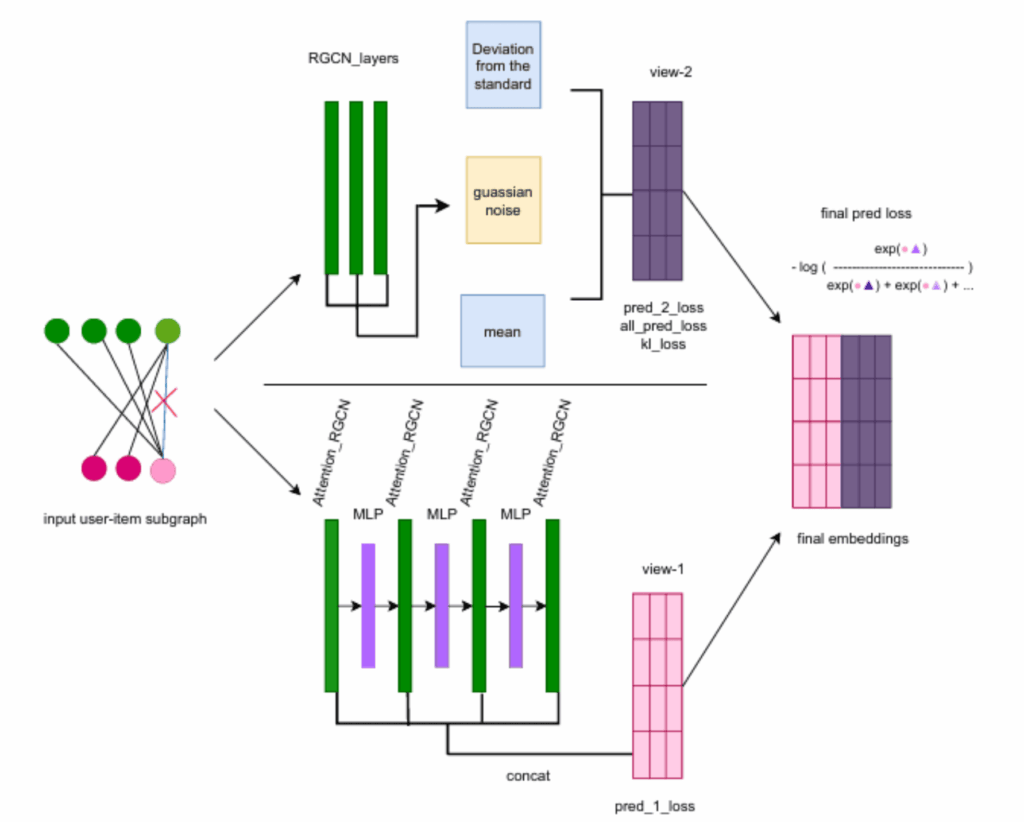
    • Local Subgraph Extraction: For each user-item pair, MCCL looks at a small neighborhood around them in the interaction graph, capturing local context.
    • Two Complementary Graph Views:
      • Denoising View: Uses an attention-based Relational Graph Convolutional Network (RGCN) to weigh edges, reducing the influence of noisy or irrelevant connections.
      • Augmented View: Employs a Graph Variational Autoencoder (GVAE) to create a latent representation aligned with a standard distribution, encouraging generalization.
    • Contrastive Mutual Learning: MCCL trains these two views to learn from each other by minimizing differences between their representations, capturing shared meaningful patterns while preserving their unique strengths.

    Why Is This Important?

    • Better Prediction Accuracy: MCCL improves rating predictions by up to 0.8% RMSE, which might seem small but is significant in recommendation contexts.
    • Enhanced Ranking Quality: It boosts how well the system ranks recommended items by up to 36%, meaning users get more relevant suggestions.
    • Robustness to Noise: By explicitly denoising the graph, MCCL reduces the risk of misleading information corrupting recommendations.
    • Generalization: The use of variational autoencoders helps the system perform well even on new, unseen data.

    The Bigger Picture

    MCCL represents a step forward in making recommender systems smarter and more reliable by:

    • Combining the strengths of graph neural networks with self-supervised contrastive learning.
    • Addressing common pitfalls like noise and overfitting in graph-based recommendation models.
    • Offering a framework that can be extended to other graph-related tasks beyond recommendations.

    Final Thoughts

    If you’re interested in how AI and graph theory come together to improve everyday tech like recommendations, MCCL is a promising development. By cleverly blending denoising and augmentation strategies within a contrastive learning setup, it pushes the boundaries of what recommender systems can achieve.

    Stay tuned for more innovations in this space — the future of personalized recommendations looks brighter than ever!

    Paper: https://arxiv.org/pdf/2506.10658

  • ELEVATE: Enhancing Large Language Models with External Knowledge and Verification

    ELEVATE: Enhancing Large Language Models with External Knowledge and Verification
    ELEVATE: Enhancing Large Language Models with External Knowledge and Verification

    Large Language Models (LLMs) have demonstrated remarkable capabilities in natural language understanding and generation. However, they often struggle with factual accuracy and reasoning consistency, especially in knowledge-intensive tasks. The paper “ELEVATE: A Framework for Enhancing Large Language Models with External Knowledge and Verification” (arXiv:2506.10790) proposes a novel approach that integrates external knowledge retrieval and verification mechanisms into LLMs to improve their reliability and factual grounding. This article summarizes the key concepts, architecture, experimental results, and implications of the ELEVATE framework.

    1. Motivation and Background

    • Challenges in LLMs: Despite their fluency, LLMs can generate hallucinated or incorrect information due to reliance on static, pre-trained knowledge.
    • Need for Knowledge Integration: Incorporating external, up-to-date knowledge sources can enhance factual accuracy.
    • Verification Importance: Ensuring generated content is consistent and verifiable is critical for trustworthy AI applications.

    2. The ELEVATE Framework

    ELEVATE is designed to augment LLMs with two main capabilities:

    2.1 External Knowledge Retrieval

    • Connects LLMs to large-scale, domain-specific knowledge bases.
    • Retrieves relevant documents or facts dynamically during inference.
    • Enables access to fresh and comprehensive information beyond training data.

    2.2 Verification Module

    • Checks the factual consistency of generated outputs against retrieved knowledge.
    • Employs a dedicated verifier model to assess truthfulness.
    • Filters or revises outputs to reduce hallucinations and errors.

    3. Architecture and Workflow

    3.1 Input Processing

    • User query or prompt is received.
    • Retriever searches the knowledge base for relevant evidence.

    3.2 Generation Phase

    • The LLM generates candidate responses conditioned on the input and retrieved information.
    • Multiple candidate outputs may be produced for verification.

    3.3 Verification Phase

    • The verifier evaluates each candidate’s factual consistency.
    • Candidates failing verification are discarded or corrected.

    3.4 Output Delivery

    • Verified, factually grounded response is returned to the user.
    • Optionally, supporting evidence documents are provided for transparency.

    4. Experimental Evaluation

    4.1 Benchmarks

    • Tested on knowledge-intensive tasks such as open-domain question answering and fact verification.
    • Datasets include Natural Questions, TriviaQA, and FEVER.

    4.2 Results

    • ELEVATE outperforms baseline LLMs without retrieval or verification.
    • Significant reduction in hallucinated or incorrect answers.
    • Improved consistency and reliability in generated responses.

    5. Advantages of ELEVATE

    • Dynamic Knowledge Access: Keeps responses current by leveraging external data.
    • Enhanced Trustworthiness: Verification ensures factual correctness.
    • Modularity: Retrieval and verification components can be updated independently.
    • Explainability: Provides evidence supporting answers, aiding user trust.

    6. Limitations and Future Work

    • Retriever Dependence: Performance hinges on the quality of retrieved documents.
    • Computational Overhead: Additional retrieval and verification steps increase latency.
    • Verifier Accuracy: Imperfect verification may still allow some errors.
    • Scalability: Integrating with very large LLMs and massive knowledge bases remains challenging.

    Future research aims to optimize retrieval efficiency, improve verifier robustness, and explore multi-modal knowledge integration.

    7. Summary

    AspectDescription
    Core IdeaAugment LLMs with external knowledge retrieval and factual verification modules.
    ArchitectureCombines retriever, generator, and verifier in a modular pipeline.
    BenefitsImproved factual accuracy, reduced hallucination, and enhanced user trust.
    EvaluationDemonstrated superior performance on multiple knowledge-intensive NLP benchmarks.
    ChallengesRetrieval quality, verification accuracy, latency, and scalability.

    Conclusion

    The ELEVATE framework represents a significant step forward in building reliable, knowledge-aware language models. By integrating external retrieval with a robust verification mechanism, it addresses key limitations of standalone LLMs, delivering more accurate and trustworthy responses. This approach opens new possibilities for deploying AI in domains where factual correctness and transparency are paramount, such as healthcare, finance, and education. Continued advancements in retrieval and verification technologies will further enhance the capabilities and adoption of such systems.

    For full details, see the original paper: arXiv:2506.10790.